In the mid-twentieth century the most common artificial respiration methods moved the victim's chest or arms, but air often failed to reach the lungs. The obstacle was above: the tongue and soft palate close the airway when a person loses consciousness.
The experiment
Peter Safar and James Elam, anaesthesiologists at Johns Hopkins Hospital in Baltimore, studied volunteers who were sedated and temporarily paralyzed to mimic a victim who is not breathing. The experiments showed how the airway obstructs in coma, how the obstruction is relieved, and that mouth-to-mouth ventilation was more effective than the chest-pressure arm-lift method.
Open the airway first; then ventilate.
Summary of the finding, not a verbatim quotation.
Timeline
| Year | Event |
|---|---|
| 1958 | Safar and Elam describe the technique: head tilt, jaw thrust and mouth-to-mouth ventilation. |
| 1958 | Paper on airway obstruction during manual and mouth-to-mouth ventilation (JAMA) and a comparison with the chest-pressure arm-lift method (N Engl J Med, with Escarraga and Elam). |
| 1958–1959 | According to a historical account, the technique is endorsed by the American Heart Association and the American Red Cross in 1958, and by the Canadian Red Cross in 1959. |
| 1959 | Safar publishes on upper airway obstruction in the unconscious patient (J Appl Physiol). |
Sources
- Encyclopaedia Britannica · Artificial respiration
- Anesthesiology · From control of airway and breathing to cardiopulmonary-cerebral resuscitation
- Pitt Med · Time of death postponed
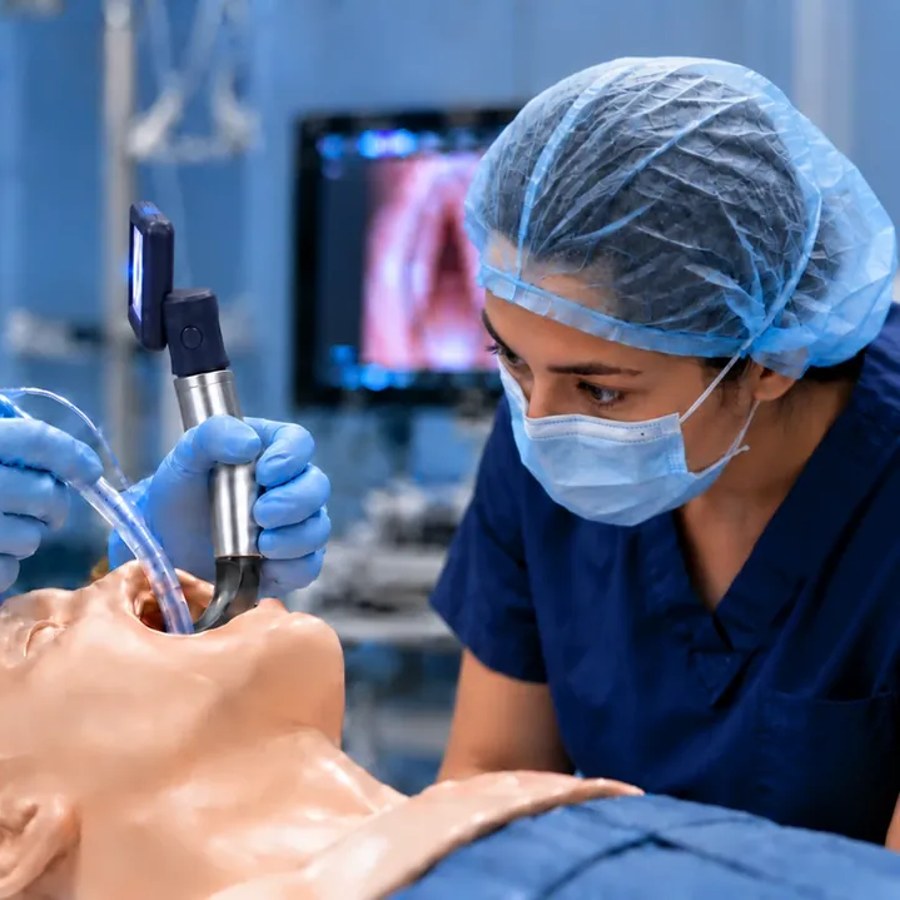
Image: Airway Zen program simulation.
Educational content; it does not replace clinical judgment or your institution's guidelines.